
Barcelona in April

Published: July 18, 2024
Waterfall feature in front of the Palau Nacional

Springtime is thought by many to be the best time to visit Barcelona. With the city still slumbering somewhat in the absence of peak-season tourists, its streets and attractions are usually relatively quiet and uncrowded. Throw in temperatures averaging between 50°F and 65°F alongside near-constant sunlight, and you can be certain a trip to Barcelona in April is sure to be a pleasant one.

Tourism in April

April serves as somewhat of a transition month for Barcelona as far as tourism concerned. It marks the boundary between the low-season winter and early spring months and the shoulder-season months leading up to summer. With that, tourism rates tend to rise gradually throughout the month.

This is what makes the spring season ideal for many visitors. While the city has yet to be bombarded by the waves of summer tourists, there are still plenty of people around to give Barcelona its trademark buzz. You’re sure to be able to visit your attractions and restaurants of choice without too much hassle, but you can also depend on the nightlife to be booming.

Take this opportunity to take a casual tour of Gaudí’s masterpieces, not last of all the Sagrada Familia and Park Güell. Walk in the footsteps of soccer legends at Camp Nou. Take a quiet stroll through Barcelona’s many famous markets, or sit back and enjoy a whirlwind tour of the city’s best attractions atop a Bus Turístic.

Easter Weekend

While Easter Sunday may sometimes fall at the end of March, it’s typically considered an April celebration. And as such, it serves as one of the best reasons to visit Barcelona in April. Visitors are welcome to join the locals in celebrating the long weekend and attending the many processions and masses taking place throughout the city.

Throughout Semana Santa, or Holy Week, the streets tend to be thriving with festivity. Alongside the religious processions, many retailers, chocolate stores and bakeries will be stocked up on festive treats and various types of Easter fare.

Just be sure to note that the Friday and Monday either side of Easter Sunday are public holidays, meaning many stores, bars and restaurants are likely to be closed. However, businesses will still typically operate under regular weekend hours on Saturday and Sunday.

Fira per la Terra (Earth Festival)

Held in conjunction with Earth Day, celebrated globally on April 22, Barcelona hosts la Fira per la Terra, or the Earth Festival. Spread across two days, the event sees locals and visitors alike come together in Parc Central de Nou Barris in celebration of the little green planet we call our home

The eco-fair typically offers an open market, live music and a host of environment-focused talks and events. Many stalls will showcase environmentally friendly products, whether locally produced, recycled, ecological or all of the above, in an effort to encourage attendees to live a more sustainable lifestyle.

There’s often quite the atmosphere throughout the festival, with attendees all sharing in their common passion to fight climate change and protect the environment. For those more activism-oriented or any visitors simply interested in attending a very wholesome event, this is not a festival to be missed!

Diada de Sant Jordi (Saint George’s Day)

Spain loves both its saints and its feast days, so the calendar is packed full of religious holidays and festivals throughout the year. Barcelona is no stranger to its own celebrations and, in many ways, likes to take each event up a step. So it should come as no surprise that the patron saint of Catalonia, Sant Jordi, is honored in a very big way indeed.

The Diada de Sant Jordi is not a public holiday, so the vast majority of stores and restaurants will remain open. And that’s just as well, because it’s also Catalonia’s answer to Valentine’s Day. Sometimes referred to as the Book and Rose Day, it’s customary for locals to gift each other – you guessed it – books and roses.

While the exchange of roses is an internationally recognized gesture of love, the swapping of books serves as a celebration of culture. On this day, La Rambla and its adjoining streets can typically be found lined with stalls offering all manner of books and flowers.

While the books at these stalls will typically be offered in a wide array of languages, the city takes this opportunity to encourage the protection and promotion of the Catalan language in particular. This annual festival continues to bring well-deserved international attention to Catalan authors and publishers, and typically sees a massive boost in their output.

It’s no coincidence that April 23 is also host to World Book Day – it was this exact festival that led the UNESCO General Assembly to declare it so! When visiting Barcelona in April, book lovers and couples alike should make their way to La Rambla to share in the city’s celebration of love and culture.

Feria de Abril (April Fair)
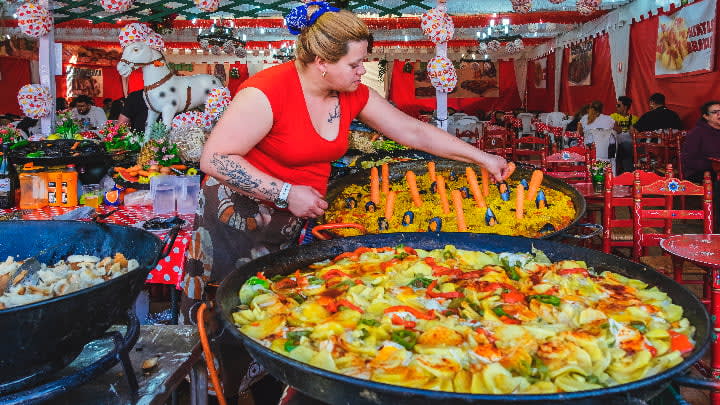
While the more famous Feria de Abril is held each year in Seville, Barcelona’s own celebration can easily hold a candle to its bigger brother. Typically held in Parc del Forum for around a week at the end of April, the festival offers a range of activities for all ages, often alongside live music and performances.

For younger visitors and families, the event offers a fairground area housing the obligatory Ferris wheel alongside various other rides, game stalls, food stands and similar amusements. The other side of the fair is composed of the casetas, a host of marquee tents housing various organizations, political parties, merchants and food stands.

The largest caseta, Caseta de la Fecac, is run by the event’s organizers and offers a series of free events and concerts by top artists and performers from around the country. If you’re in Barcelona in April and enjoy the atmosphere of a classic fair, be sure to pencil the Feria de Abril into your itinerary.

Wrapping Up

For many, Barcelona in April is nothing short of idyllic. With just enough crowds to give the city its renowned bustling atmosphere without clogging up the top attractions, visitors can be sure they’ll be getting the very best of both worlds.

And with such engaging events taking place throughout the month, there’s certainly no shortage of festivity. Whether you’re looking for a quieter time to explore the city’s famous architecture, an opportunity to stroll through its many famous parks in pleasant weather or simply the chance to let loose in the evening, April could be the perfect time to plan your trip to Barcelona.

Robert Heaney
Go City Travel Expert

Continue reading

Firework display over the Font Magica de Montjuïc on New Year's Eve
Blog

Barcelona in January

When planning a trip to Barcelona, your mind likely goes straight to summer, when the city sees its peak tourism. However, should you find yourself looking to take a trip in winter, you may see a side to the Catalan capital that most outsiders rarely do. Barcelona in January may be quieter than during the rest of the year, but that makes it a fantastic time to see the city in its most authentic state. What's more, should you be partial to a party or two, there's plenty of festivity to get you through the month. Tourism in January So long as you’re prepared to pack a raincoat and put your ideas of a beach holiday on the backburner, visiting Barcelona in January may prove a real treat. Throughout the wee months of the new year, the city sees its lowest rates of tourism, which for the most part should work very much in your favor. In the absence of the bustling droves of summer tourists, Barcelona is as tranquil as it gets come January. That means those choosing to visit in this period will get the pick of the litter when it comes to hotels, with the added benefit of comparatively lower prices. What that also means for you in your winter wanderlust is that you’ll get to experience everything that the city has to offer without much hassle at all. With fewer crowds, you won’t have to book attractions as early as you might in summer, with some often even available to book on the day. Take yourself on a tour of Barcelona’s attractions without having to fight for the sights. Bask in the awe-inspiring architecture of the Sagrada Familia, and explore the city’s ancient markets like a local. And if you’re an early riser, why not catch the sunrise over at Park Güell, too? That isn’t to say Barcelona is devoid of any tourism throughout this period, though. On the contrary, there’s often still a very healthy buzz to the city around this time. In place of the usual tourist crowds, you’ll find many more locals frequenting bars and restaurants in the center than most other times of the year, giving the city a real authentic buzz. Ski Season With the local ski season in full swing, a good portion of visitors to Barcelona in January are naturally there to take advantage of its prime location. With as many as 14 fantastic alpine resorts within a few hours’ drive from the city, Barcelona serves as a perfect hub for skiing enthusiasts. Take a day or two to gear up before a week's trip to one of the nearby resorts, or embrace the best of both worlds in skiing through the day and returning to Barcelona in the evening. New Year’s Eve Right from the get-go, both visitors and locals to Barcelona come together to see in the new year in style. Known as as Nochevieja in Spanish, New Year’s Eve celebrations take place throughout the city, with the most notable celebration taking place on Plaça d'Espanya by the Font Magica on Montjuïc, complete with the obligatory countdown and firework display. In the leadup to the countdown, one of the biggest parties takes place at the Poble Español close by, offering various different music zones for fans of all genres. Up to a thousand people typically come from the world over to party until dawn. Down in the city, many others still gather on Plaça Catalunya, often with a bottle of Cava in hand. At the stroke of midnight, many will then collectively throw their bottles into the street in celebration – much to the dismay of those who have to clean up in the morning! Kings’ Day The rest of January isn’t without its fair share of festivity either. Right away, just as the streets have been cleared up after New Year’s Eve, the city celebrates Kings’ Day. In tribute to the day that the Three Kings visited the baby Jesus in Bethlehem, Barcelona welcomes their ceremonial arrival on the evening of 5 January. The Three Kings arrive by boat before beginning their annual procession through the streets of Barcelona. Traditionally, children in Spain write letters to the kings in place of Santa Claus, and on Kings’ Day they receive their gifts. If you happen to be visiting around Kings’ Day, be sure to catch the parade and take part in some of the many local festivities. Locals are likely to be throwing parties, and stores and bakeries will be full of festive sweet treats to try out, such as Tortells de Reis, or Kings’ Cakes. La Festa dels Tres Tombs Kids and animal lovers alike are bound to get a kick out of this Catalan celebration. The Festa Major de Sant Antoni is celebrated on 17 January in honor of Saint Anthony, who was said to have used his healing capabilities to save a number of animals. On the first Saturday following this feast, La Festa dels Tres Tombs sees a procession of animals such as horses and donkeys parade through the streets around the Escola Pia de Sant Antoni. Alongside the parade, you can also expect to find the streets lined with stalls selling various treats and local crafts. Wrapping Up Barcelona in January may not typically top everyone’s bucket list, but that doesn’t mean you should rule it out. The beginning of the new year is a perfect time to experience all that the heart of Catalonia has to offer without having to battle the summer crowds. Whether you’re an avid skier, a fiend for festivities or simply want to see Barcelona at its most tranquil, January is a fantastic time to plan a visit. Just be sure to pack for the weather!
Robert Heaney
barcelona neighborhoods
Blog

Where To Stay in Barcelona

If you're planning a vacation in Barcelona, you may already have a pretty good idea of what to expect. Delicious food, warm temperatures, and heaps of wonderful Mediterranean architecture bring millions to the city every year. But where are the best places to stay in Barcelona? Well, we've committed to key research just for you. So read on, and find out where is the best place for you to stay in Barcelona! Including: Plaza de Catalunya Barri Gotic El Raval El Born Eixample and more!   Plaza de Catalunya If you want to be in the thick of the Catalan capital, then look for a place in Plaza de Catalunya. Right in the center of Barcelona, it gives you a great jumping-off point to travel from as you explore. You'll be surrounded by high street shops, markets, coffee houses, places to eat, and things to do, so really, it's the perfect place to set up a basecamp if you've never visited Barcelona before. La Boqueria, one of Barcelona's best and oldest markets, is a short walk away, so if you're staying in an Airbnb and you need fresh food, it should be your first port of call every morning. And museums like MACBA, or Museu d'Art Contemporani de Barcelona, are right around the corner   Gothic Quarter Looking for something a little older with a touch more atmosphere? Barcelona's Gothic Quarter is, predictably, one of the oldest parts of the city. Wandering its streets, you'll see untouched architecture that dates back to the Middle Ages. It's a more old-school, slapdash approach to city planning you won't find in many other tourist cities. You'll find plenty of markets here, as well as local restaurants and family-owned stores. A far cry from Plaza de Catalunya's high-street affair, but you'll find things in the Gothic Quarter you won't find anywhere else on Earth. As far as things to do, Güell Palace, one of Gaudi's earliest buildings, is right nearby. So go look at it, take pictures aplenty, and bask in its brilliance.   El Raval The city's multicultural heart, El Raval is one of the most fun districts in the city. Brimming with bars, clubs, and live music, if you want the full Catalonian experience, not many places do it better. Fresh food lovers or general deal-seekers should go check out Mercat de Sant Antoni for all their bartering needs. And, if the language barrier isn't an issue, there are also a slew of theaters putting on myriad shows for you to enjoy. Photo-lovers also owe it to themselves to snap a pic of the famous El Gat de Botero, an enormous bronze cat statue by revered artist Fernando Botero.   El Born What was once home to the ruling classes of old Barcelona has now blossomed into a lively neighborhood while still keeping much of the architectural splendor of the past. Alongside all the history, you'll find local shops and restaurants that'll open their doors to you. As for entertainment, you're a bit spoiled for choice here. Besides the numerous local art galleries, you can also visit the likes of the Picasso Museum and see some of the world-famous painter's works, or go for something more modern thanks to the Moco Museum, which showcases eye-opening modern art from Banksy and other genre heavyweights. If you want a taste of local life with a few extra frills, El Born has got you covered.   Eixample Right off of Plaza de Catalunya, you'll find Eixample, one of Barcelona's more bustling neighborhoods. One of the city's biggest districts, you'll find plenty of touristy delights within its formidable borders. While it contains more restaurants, bars, and cafes than you'll visit in a lifetime, its crowning jewels are perhaps two of Gaudi's most famous works, Casa Battló and La Sagrada Familia. The mind-blowing buildings are two of the city's biggest tourist attractions, so prepare to queue if you do visit. Besides all that, you'll find the city's biggest flea market, called Mercat Els Encants, where you can pick up pretty much anything. And you'll be a short walk from La Ciutadella Park. If you fancy it, take a Segway tour of the park to see the sights in a more unusual fashion!   Passeig de Gracia One of the fancier parts of the city, Passeig de Gracia is Barcelona's very own mini-Manhattan. Grand old mansions, opulent shopping, and designer-draped denizens are all on display. If you wish to mimic the class of the locals, you'll have plenty of opportunities to, thanks to the myriad designer stores and luxury labels on offer. And, for the culture vultures, check out the Placa de Catalunya, a beautiful central square full of sculptures, and another of Gaudi's famed works, La Pedera.   La Barceloneta Want a little sand and sea with your stay? Why not pitch your tent around La Barceloneta, the city's seaside district? Of course, the highlight of the neighborhood is undoubtedly Barceloneta Beach. It's the city's most popular beach for a reason, thanks to its proximity to the city center, a load of seaside bars and restaurants selling fresh fish, and the many watersports people can take part in. In fact, other than the Museu d'Historia de Catalunya, where you can learn all about the city's rich and long history, nearly everything else is beach or ocean-related. However, given how close the city's amenities are, it's still more than worthwhile to stay there and simply travel into the heart of Barcelona when you want to see and do touristy things. After all, nothing quite beats a sea view in the morning!   La Vila Olímpica And finally, we end our recommendations for where to stay in Barcelona with a more modern site. La Vila Olímpica was once the Olympic Village during the 1992 Barcelona Games, but has since evolved into its very own neighborhood, with bars, restaurants, and beaches ripe for a vacation destination! A stone's throw from the Barceloneta seaside, while many consider it to be part of that neighborhood, it's developed something of its own identity in the decades since the Olympics. With its goldilocks placement between the beach and the city center, it could be the perfect place to set up your basecamp! And you'll hardly say no to the amenities on your doorstep either! And those are our recommendations of where to stay in Barcelona! If you need a good choice of accommodation then you can browse hotels in Barcelona for a range of hotel options in the city.
Dom Bewley
View over Park Güell at sunset
Blog

Barcelona in February

When planning your trip to Barcelona, you’d be forgiven for not considering visiting in winter. With the city seeing its peak levels of tourism in the summer months, it only seems right to follow suit and experience the city in its warmest and most bustling period. But should you happen to take a chance on Barcelona in February and brave the slightly cooler and possibly wetter weather, you may find yourself pleasantly surprised by what the city has to offer. Not only will you be able to experience a more authentic side to the Catalan metropolis without having to fight the summer crowds, but you’ll also get the chance to observe some of the region’s most hotly-anticipated cultural events. Tourism in February If you happen to visit Barcelona any time outside of the summer period, you’ll very quickly notice a huge difference in the overall feel of the city. In the wake of or lead-up to the peak tourist season, the city sees far lower numbers of visitors. This is especially true in the late winter months, when even the additional mini waves of Christmas have all run dry. In the absence of peak visitor numbers, you’ll find Barcelona far less crowded, and that can make a whole lot of difference for your trip. You’ll have the opportunity to visit just about any of the city’s key attractions without having to battle crowds, and most of the time you should even be able to book admission the very same day. What’s more, you’re likely to get the pick of the litter in terms of flights and accommodation, along with some pretty hefty discounts to boot. While it may not be the perfect weather for taking a dip in the Mediterranean, with temperatures typically falling between the low-40s and high-50s, this could be the prime time to plan your dream Barcelona itinerary. Explore the likes of the Sagrada Familia, Park Güell, Montjuïc and the Barcelona Zoo in their quietest and most authentic state. Barcelona Carnival We promised you near-zero crowds throughout Barcelona in February. Well, that may not be strictly true for the whole month. While most tourists may indeed be waiting for the summer months to pay a visit, the locals come out in force for a week in mid-February to celebrate Carnival. In the lead-up to lent, when families would traditionally begin fasting to tribute the final sacrifice of Jesus Christ, the city indulges in a week of lavish eating, drinking and partying. The celebration begins with Dijous Gras, or Fat Thursday. As per its double-entendre name, this is a day full of indulgence in mighty communal feasts filled with greasy, fatty foods. Head to any independent bakery or café, and you’ll likely find traditional treats such as coca de llardons (a flat wheat pastry) and botifarra d’ou (pork and egg sausage). Sometime over the weekend, often on the Saturday, the Carnival King will then arrive among the traditional carnival parade before making his grand speech to commence the rest of the festivities. This is a huge event in which many locals and tourists alike will gather to hear the King poke fun at the year’s most poignant events. Throughout the Carnival period, you’ll find countless street parties and events to join where you’ll be able to indulge in your fill of festive foods and alcohol. Most attendees typically dress up in costume, often as celebrities, famous characters or animals. If you’re really looking to party, you can easily grab yourself a costume from a number of stores in the city center. Llum Festival February also offers up one of the most highly anticipated events on Barcelona’s cultural calendar. For three nights a year, the Poblenou district offers up an almost unparalleled light show for the Llum Festival, using many of the district’s most iconic buildings as a canvas on which to project various different stunning art displays. Should you find yourself exploring the trendy bars, cafés and retailers throughout this district in the evening, you’ll be treated by all manner of spectacles. Highlighting the skills of both local and A-list artists, installations can be anything from neon walkways to immersive 3D illusions to entire buildings animated by light. Chinese New Year While the Lunar New Year may occasionally fall in January, it most often takes place in February. Just about every major European city will offer some form of celebration, but some go above and beyond to offer something truly special. Barcelona is one such location, as it has adapted its Chinese New Year celebrations to incorporate both traditional Chinese and Catalan symbolism and culture. A procession of dancers, musicians, martial artists, human towers, Chinese dragons and Catalan giants typically makes its way through some of the city’s major streets, eventually ending in a grand performance at its final destination. To accompany the celebration, you’ll also find a number of smaller events and displays taking place throughout the city. Many streets are taken over by vendors selling all manner of traditional treats and gifts, and you can often find a number of cultural workshops offering everything from language classes to art to cookery. Wrapping Up Whether you’re a more budget-minded traveler looking for the cheapest and quietest time to experience the heart of Catalonia or a fiend for parties and festivities, visiting Barcelona in February can be incredibly rewarding. Minimal crowds, cheaper accommodation rates and some of Catalonia’s most exciting cultural events are but a few of the treats you can expect from a visit throughout this period. Grab yourself a plane ticket and make sure to pack for the weather, and see what Barcelona’s winter really has to offer.
Robert Heaney

Have a 5% discount, on us!

Sign up to our newsletter and receive exclusive discounts, trip inspiration and attraction updates straight to your inbox.