
Rome in February

Published: July 18, 2024
Saint Peter's Basilica and Ponte Sant Angelo reflected in the River Tiber

Celebrated home to many of Europe’s most famous cultural and historical attractions, Rome presents a unique concoction of both low-season calm and celebratory chaos throughout February. No matter your preferences, whether you’d rather explore the city’s famous sights without the crowds or join in on a city-wide street party, Rome in February has it all.

Visiting Rome in February
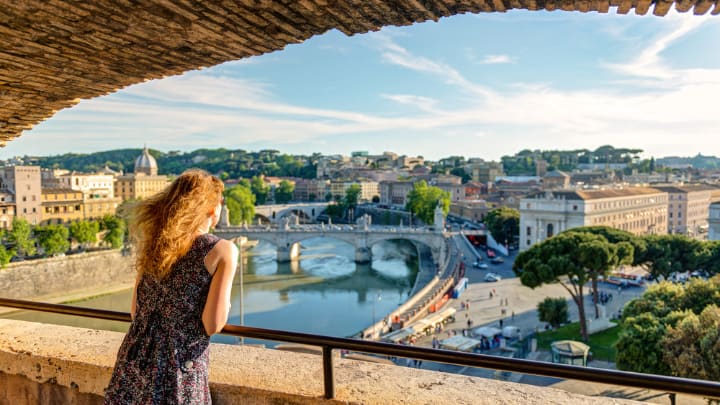
Image of Photography, Cityscape, Urban, City, Adult, Female, Person, Woman, Nature, Outdoors, Scenery, Car,

Average Temperature: 37 - 57°F • Average Rainfall: 6 days/mth • Average Sunshine: 5 hours/day

Continuing the trend set throughout January, Rome in February maintains a relatively low throughput of tourists. While the Italian capital is never truly quiet, owing to its largely evergreen key attractions, this period stands as one of the best times to see Rome in its most serene, authentic state.

That being said, events in February such as Carnevale and Valentine’s Day are very much an exception to Rome’s low-season serenity. These celebrations help to create a truly electric atmosphere throughout the city, but they also come at the cost of much busier venues and attractions. Whether these are the ideal times for you to visit will depend entirely on your own preferences.

Rome’s weather stays relatively consistent throughout winter, with February temperatures typically drifting between a little above freezing and mildly comfortable. With at least one day of rainfall likely per week to complement the cooler winter climate, you’ll want to make sure to pack appropriately if you plan on exploring more of the city’s open-air attractions.

Things to do in February

Image of City, Urban, Metropolis, Water,

The winter low season is a fantastic time to experience some of Rome’s most iconic landmarks in relative peace. While the likes of Trevi Fountain, the Spanish Steps and Piazza Navona are notorious for drawing in a constant stream of tourists, they aren’t nearly as busy during this period as in the busier summer months. Be sure to come early in the day if you want to snap that perfect shot ahead of the crowds.

Also worth a visit in February are the Vatican Museums, Sistine Chapel and St. Peter’s Basilica, now in one of their most serene periods between the religious festivities of the festive season and Lent. Take this opportunity to explore one of the world’s most impressive collections of historical artifacts and artworks, and admire the impressive master architecture of two of the world’s most iconic religious sites.

In much the same way, winter’s smaller tourism scene makes February a great time to explore more of the country’s best offerings. With Naples, Florence and Pompeii just a little over an hour’s train journey away from Rome, a day trip is more than enough time to experience more of Italy’s world-renowned culture, cuisine and history.

If you’re looking for something of a different experience of the Italian capital, take some time to discover the more macabre side to the city. The Roman Catacombs stretch for miles beneath the city, lined with the skeletons of a civilization now long passed, while the likes of a Dark Rome tour takes visitors on a stroll through some of Rome’s darkest and most fascinating stories and legends, from gritty historical events to whispers of the supernatural.

What's On in February

Image of Carnival, Adult, Bride, Female, Person, Woman,

Carnevale di Roma

With roots as far back as the 12th Century, Carnevale is one of Rome’s most hotly anticipated annual events. For eight straight days, the city of Rome comes to a near-complete standstill as thousands of locals and visitors alike take to the streets to revel in all manner of colorful festivities.

Historically, the festival stood as a final chance to feast and party in the lead-up to Lent. Alongside much dancing, singing, eating and drinking, the celebration was often punctuated by impressive duels, bullfights, parades and a particularly popular riderless horse race. Although some of these events may have since fallen out of practice, the same jovial merriment is still very much alive in today’s Carnevale.

Piazza di Spagna, Piazza Navona and Piazza della Repubblica are often the main epicenter of festivities, erupting into great street parties complete with events and entertainment for all ages. Another popular venue is Castel Sant’Angelo, where you can typically find live music performances and a generally electric buzz, often along with an artificial ice rink.

While the traditional Berber horse race fell into oblivion long ago, horses still play an important role in the festival. The race has since been succeeded by a horse-back costumed parade throughout Rome’s historic streets, often joined and escorted by horses from the military’s own equestrian unit. A large equestrian show takes place later in the festival, with horses performing all manner of impressive acrobats and dressage, where children may also be offered free horse-back rides.

Those already familiar with Carnevale celebrations in Europe in general may already be aware that Italy’s most popular and famous celebration actually takes place in Venice rather than Rome. If you’re looking to join the very best festivities that Italy has to offer, Rome simply pales in comparison to the colorfully chaotic street parties of Carnevale in Venice.

Valentine's Day

One of Europe’s most famously romantic cities, there are few better places than Rome to spend Valentine’s Day. Take a relaxing evening stroll along the banks of the Tiber, enjoy a candlelit dinner at a charming Italian restaurant, gaze up at the stars from one of the city’s many popular trattorias or take part in one of many possible couple-friendly activities.

Many restaurants and venues throughout the city take the opportunity to offer special menus, products and discounts on and around February 14, resulting in almost endless ways to really treat that special someone. We’d recommend you make plans and bookings ahead of time to avoid any disappointment on the day

Robert Heaney
Go City Travel Expert

Continue reading

The Parco degli Acquedotti at sunset
Blog

Rome in August

Carrying on the summertime buzz from July, Rome remains well and truly in its prime in August. Alongside its near-perfect Mediterranean weather, world-class cuisine and wealth of fantastic heritage sites, Rome in August puts on a great spread of seasonal events and festivals to add to its already renowned bustling and electric atmosphere. Visiting Rome in August Average Temperature: 64 - 86°F • Average Rainfall: – days/mth • Average Sunshine: 10 hours/day As far as tourism goes, August is the big boy for Rome. Deep into the academic summer break, many families, couples and individuals alike flock to the eternal city to make the most of its unparalleled summertime charm. While that does mean you should be prepared for plenty of queueing and advance booking for top attractions and venues, it also lends itself to the city’s famous citywide buzz. There are few better times than August to enjoy the very best of Rome’s idyllic Mediterranean climate. Combining near-constant sunshine with typically very warm temperatures and next to no rain throughout the month, this is a wonderful time for sunbathing in one of Rome’s many open green spaces or enjoying a glass of local wine on a traditional Italian terrace. Things to do in August Just about any trip to the eternal city is simply destined to include its most iconic UNESCO World Heritage Sites. Both the Colosseum, the world’s largest-standing ancient amphitheater, and the Pantheon, a former Roman temple, offer unique insights into the day-to-day lives and culture of the now long-gone Roman empire. In much the same way, the whispers of Europe’s most influential historical empire can still be heard among the ruins of the Roman Forum, once the site of many key administrative buildings. The oldest remnants of the Roman empire can be found atop Palatine Hill, where Rome was first founded and the supposed site of the fabled Lupercal cave of ancient Roman myth. Equally central to Rome’s historical and cultural appeal is its status as home to the beating heart of Roman Catholicism. Vatican City is simultaneously one of the world’s most lauded religious sites, the permanent residence of the Pope and the smallest country on the planet. Adding to that are the fact that it boasts the stunning artwork and architecture of the Sistine Chapel and St. Peter’s Basilica, alongside one of the world’s largest historical art collections housed within the Vatican Museums. If you know anything about Rome’s top sites, though, then you’ll be well aware that some of its top sights are far more modern. The graceful sculpture work of the Trevi Fountain and the sleek Spanish Steps linking Piazza di Spagna to Piazza Trinità dei Monti offer some of the capital’s most sought-after photo ops for their iconic architecture. With Rome’s weather currently at its finest, it’d be a shame not to spend a free day or two exploring and lounging in some of the city’s open, green spaces. Among the best of these are the 100-plus-acre wooded glades of Villa Borghese and the unparalleled views atop Pincio Hill, alongside the impressive display of international foliage living among the Botanical Garden. Should you find yourself with a day or two to spare, the likes of Florence, Naples and Pompeii each make for a fantastic day trip. Just a short train ride away from Rome, these and other nearby towns all offer a fantastic opportunity to explore more of what Italy has to offer, from its world-renowned cuisine to its rich and diverse historical sites. What’s On in August Isola del Cinema Each summer, Tiber Island, located between Pons Fabricius and the Trastevere district, transforms into the magical Isola del Cinema, or Isle of Cinema. Over the course of several weeks throughout the summer period, the island becomes the epicenter of visual entertainment with a vibrant and evocative film festival dedicated to bringing to the limelight the best in Italian cinema. Inviting directors, actors, producers, screenwriters, musicians and film aficionados alike, the festival operates a vast program of outdoor screenings of great Italian films, alongside many critically-acclaimed international offerings from over 100 countries. Works on display typically include everything from full-length features and short films to virtual reality gaming experiences. Concerti del Tempietto Throughout summer, the ancient open-air Theater of Marcellus among the ruins of the Temple of Apollo Sosianus comes alive with an historic Roman music festival. For roughly three months, the Concerti del Tempietto puts on an impressive program of concerts across a wide range of genres. Musicians both established and niche offer everything from classical concerts and opera arias to pop and jazz performances. Tickets to the festival typically include a guided tour of the archaeological park around the Theater of Marcellus, both in Italian and English, exploring the parallels between the venue’s modern day role and its original dedication to performing arts twenty centuries ago. Lungo il Tevere One of the most hotly anticipated festivals of the year, Lungo il Tevere (‘Along the Tiber’) attracts hordes of visitors keen to join in on its unique and exciting program of riverside events and activities. It isn’t difficult to notice when the festival comes to town, with the banks of the Tiber simply brimming with all manner of event stands, art installations and interactive exhibits. The event typically lasts the duration of summer, with a vast program of evening shows, performances, improvised theater and live music concerts by local bands at its core. During the daytime, though, the venue stands as somewhat of an interactive expo of art installations, unique photo ops and street arcade games like air hockey and foosball. Usually accompanying the festival is a market of local vendors selling all manner of wares, from vintage records to hand-crafted jewelry. Sometimes present at the market are the likes of tarot readers and petting zoos hosted by local animal shelters charities. The festival also hosts a number of pop-up restaurants, cafés and bars, offering cuisine and beverages both local and international.
Robert Heaney
Statue of Caesar and a rainbow in Rome
Blog

Things to do in Rome for Pride Day

Rome has more layers than a prize-winning onion. It’s a city where deeply held religious beliefs (*cough* the Vatican *cough*) can live side by side with a thriving LGBTQ+ community, and an annual Pride celebration that turns the ancient, timeworn streets into rainbow-colored rivers of love, joy and inclusion. There’s stacks to do across Roma Pride weekend and indeed through the rest of the hot Italian summer. So, without further ado, here are some of the best things to do in Rome for Pride Day and beyond. Roma Pride Parade While not as fulsomely flamboyant as Pride parades in more progressive Italian cities like Milan, Rome’s June party still packs a punch. The parade has been running here since 1994, drawing thousands of revelers keen to catch a glimpse of the ostentatious floats, outlandish costumes and fabulous drag queens as they weave their colorful way south from the Piazza della Repubblica to the ancient Roman Baths of Caracalla, passing such little-known Rome attractions as the Colosseum and Santa Maria Maggiore Basilica along the way. The parade usually takes place on a Saturday in mid-June, kicking off in the afternoon, around 3PM.  Roma Pride: Art and Culture The Pride Croisette is a festival of art and culture that runs for the two weeks up to and including Pride Day, promising music, comedy, debates and more drag acts that you can shake a pink feather boa at. The Pride festival culminates on Saturday night with a huge ticketed event: Rock Me Pride brings together dozens of acts – from rock stars to drag queens – at the Capannelle Racecourse. Get info and listings for the Pride Croisette and Rock Me Pride party on the official Roma Pride website here. Gay Street The clue’s in the name here. Ok ok, so the real name of this LGBTQ+ enclave opposite the Colosseum is ‘Via di San Giovanni in Laterano’, but just try asking for directions to that after a couple of aperol spritzes. There’s a party going on along this lively cobbled lane year-round, but things hit a high on Pride weekend when crowds of colorful punters make a beeline for the bars here after the parade, filling the street with laughter, song and often incredible garb as the festivities continue well into the night. Rome’s LGBTQ+ Nightlife Rome isn’t exactly heaving with LGBTQ-friendly bars and clubs outside of Gay Street. But those that have established themselves will certainly be running special events and Pride-themed parties on the Saturday night after the parade. Try the 101 Club near Rome’s Termini Station. Or hit up its near neighbor, the smoky basement bar that is Company Roma (note: you’ll need to purchase a membership card at the entrance for this one). Over in the Pigneto district, the Malo Glitter Bar is your place for cool cocktails and craft beers, with a side order of cabaret, drag shows, comedy and other live entertainment on its small stage. Gay Village The party doesn’t stop just because Pride proper is over. No sir! Gay Village is a summer-long shindig and the largest LGBTQ+ festival in Italy, running between June and September in the Parco del Ninfeo south of the city center. For 15 weeks, the historic park is transformed, becoming a vast outdoor entertainment complex complete with bars, dance floors, an outdoor cinema, open-air gym and more. Expect a great big joyous love-in with theater, fun competitions, art shows and – on weekends – the biggest, most hedonistic LGBTQ+ party in town. The park is free to enter Sunday-Wednesday but there’s a fee Thursday-Saturday. Some events in the park – generally those involving the biggest international DJs and performers – are also ticketed. But what price an unforgettable summer of love? The Baths of Caracalla… and Beyond When in Rome, do as the Romans do… and head for the thermal baths. Hit up the Insta-perfect Baths of Caracalla for a taster: this ancient complex features beautifully-preserved floor mosaics, soaring honey-stone arches, and a tepidarium, and would have accommodated some 1,500 bathers in its 3rd-Century heyday. Having boned up on your Roman bathing history, try the real thing at some of the city’s top gay saunas and bathhouses for men only; Adam, Apollion and Illumined are among the most popular. LGBTQ-Friendly Neighborhoods in Rome Clinging to opposite sides of the Tiber, just south of the Centro Storico, the hip ‘hoods of Trastevere and Ostiense are among some of the most welcoming and inclusive in Rome. Trastevere’s café-lined piazzas and cute ocher-colored houses are manna for Insta addicts, while Ostiense has a cooler, more industrial vibe. Both are chock-full of trendy young bars, trattorias and gelaterias, as well as some of the finest contemporary galleries and street art in town. Hit up Tridente in the center for high-end Italian fashion boutiques and the chance to make a wish at the Trevi Fountain, or make for the tiny fairytale enclave of Quartiere Coppedè, with its ornate fountains, Florentine towers, baroque palazzi and swoonsome Moorish arches.  Read our guide to Rome’s best neighborhoods here. Best of the Rest: Rome’s Top Attractions So you’re in Rome for Pride and to sample the best of the Eternal City’s LGBTQ+ nightlife. But don’t let that stop you from also checking out Rome’s many, many attractions. You could save up to 50% on a wide variety of tours, activities and attractions with a Go Rome pass. We’re talking some of the biggest and best bucket-listers in town, including… Skip-the-line entry to the Vatican and Michelangelo’s extraordinary Sistine Chapel ceiling frescoes. An audio-guided tour of Ancient Rome’s big three: the Colosseum, Roman Forum and Palatine Hill. The immersive Leonardo da Vinci Experience, featuring faithful reproductions of the maestro’s paintings and inventions. Pizza and wine-tasting experiences by the Colosseum. Cocktails by the Spanish Steps. A sweet-lover’s dream-come-true: an epic gelato, espresso and tiramisu tour. … and many many more! Find out more and get your Rome attractions pass here.
Stuart Bak
Stuart Bak
Couple descending the Spanish Steps in Rome, with the Trinità dei Monti church behind them
Blog

Free Things to do in Rome

It’s a truth universally acknowledged that the best things in life are free, and perhaps nowhere more so than in Rome, where access to some of the finest churches and monuments on the planet is absolutely gratis. Visiting Insta-perfect attractions like the Trevi Fountain and Pantheon won’t cost you a cent, while many popular museums throw open their doors for nada on the last Sunday of the month. Follow our guide to free things to do in Rome and the only thing you’ll have to pay for is the irresistible gelato. Tick Off the Big Hitters Many of Rome’s most famous monuments are yours to visit for free. Let’s begin with the Trevi Fountain, that gloriously baroque 18th-century water feature where you must face the existential question: can an attraction truly be said to be free if you feel compelled, almost against your own will, to throw a coin into it? As you contemplate this conundrum, remember that must-see attractions with no entrance fees tend to lead to hordes of camera-toting tourists. Night owls can dodge the crowds by visiting during the quieter hours: between 3am and 6am, to be precise. Much like wading in the Trevi Fountain, pausing to sit on the nearby Spanish Steps is no longer permitted, so steel yourself for the 135-step climb up this national monument to the majestic Trinità dei Monti church at its summit. Like all of the Eternal City's near-1,000 churches, this Renaissance confection is free to enter, and has riches inside to rival the very best of Rome's museums and galleries. Expect stunning decorative features including a pair of anamorphic frescoes from the 17th Century that give wildly different perspectives depending on where you stand. The Pantheon is one of the best-preserved examples of Ancient Roman architecture on the planet. Better still, you can visit for free. Step between the iconic Corinthian columns and inside this vast masterpiece of Roman engineering, its vast roof still the largest unreinforced concrete dome in the world, a mere 2,000 years after its construction. Visit during a heavy downpour to experience the column of water that cascades down from the oculus (an opening in the center of the dome) and drains away through discrete holes in the floor 142 feet below. Admission is free from Monday to Friday. Some of Rome’s other bucket-list attractions offer free entry on select days. This tends to be the first or last Sunday of the month for museums including – deep breath – the Galleria Borghese, the Roman Forum, the Baths of Caracalla, the Vatican Museums, the papal audience and the Colosseum, as well as dozens more obscure sites. Dates are subject to change, so do check in with your chosen attraction(s) before turning up on a random Tuesday in August insisting on free entry. Then there are the free walking tours, like this one. Ok, so they’re not strictly gratis in that you’re expected (but not required) to pay your expert guide whatever you think the tour is worth, but they do represent great value and are a fine way to find your bearings among the Eternal City’s cobbled lanes, ancient ruins and baroque piazzas. Get Snap Happy! It goes without saying that romantic Rome is one of the most photogenic cities in the world, so grab your camera, compose your image, and get ready to capture shots that will make you the envy of even the most seasoned Instagram influencer. Quirky Quartiere Coppedè is a photographer’s dream, with fairytale fountains, Moorish arches and a fantastical jumble of architectural styles, from Ancient Roman to Art Nouveau, that just beg to be snapped. Don’t miss the elaborate Fountain of Frogs, and the enormous iron chandelier that dangles over the Via Tagliamento entrance. Hidden away through the unassuming Arco degli Acetari archway just off Campo de' Fiori lies another picture-postcard scene – a tiny medieval courtyard with quaint rust-colored houses festooned with lush green foliage and flower-filled window boxes. Cats snooze on the cobbles in the afternoon sun, providing budding snappers with some fine shots of Rome at its sleepiest. Peep through the otherwise unremarkable Aventine Keyhole at the Villa del Priorato di Malta for one of the most Instagrammable views you’ll find anywhere in Rome. For through that keyhole lies a perfectly framed image of distant St Peter's Basilica flanked by the villa’s manicured cypress trees. It’s not known whether the door and its lock were deliberately designed this way, but it’s an almost unbelievably serendipitous result if not. Parks, Piazzas and Ancient Avenues There are worse ways to while away a few hours than to roam Rome’s stunning parks, or find a spot on a busy piazza to devour a gelato and watch the world go by. There’s plenty of free entertainment to be had in Villa Borghese, where charming tree-lined avenues lead to formal gardens, babbling fountains and grand villas and monuments. View the 18th-century Temple of Aesculapius from the lake shore or pay the nominal fee to rent a boat and get up close. The Carlo Bilotti Museum is also free of charge and contains a collection of works by Italian surrealist Giorgio de Chirico as well as pieces by Andy Warhol and Gino Severini. There’s also an excellent playground where kids can let off steam while parents perk up with an espresso from the café. Don’t miss Rome’s most celebrated public squares. Sprawling Piazzo Navona contains not one but two Bernini masterpieces, including his magnificent Fountain of the Four Rivers. Visit in the evening, when its waters are illuminated and the piazza is abuzz with locals out for an evening stroll, or on their way to dinner. Meanwhile, gelato and people-watching is the order of the day on the Campo de' Fiori, where a daily market fills the air with heady aromas of warm bread, farm-fresh cheeses and just-picked flowers. Last but by no means least, a walk on the Appian Way is hands-down one of the best free things to do in Rome. This ancient Roman road stretches south out of the city, with much of it remaining unchanged in centuries. Indeed, some of the views will be much the same as those seen by Julius Caesar and his armies as they marched this strategic route over 2,000 years ago. It’s a superb cobbled avenue flanked by soaring pine trees and fields in which evocative Roman ruins and tombs can often be spotted. Take a bike or take the bus but – most importantly of all – take a camera and a picnic. Save on things to do in Rome Save on admission to Rome attractions with Go City. Check out @GoCity on Instagram and Facebook for the latest top tips and attraction info.
Stuart Bak
Stuart Bak

Have a 5% discount, on us!

Sign up to our newsletter and receive exclusive discounts, trip inspiration and attraction updates straight to your inbox.