
Things to do in Barcelona for Couples

Published: July 18, 2024
Couple overlooking Barcelona from a rooftop

Known among many other top European cities for its wealth of culture, history, world-class cuisine and top-notch nightlife, Barcelona is a city brimming with romantic appeal. Couples looking for an intimate city escape with Spanish and Catalan flavors would be hard pressed not to find the Catalan capital an ideal destination.

Beyond the natural charm of its architecture, traditions and people, there is also a whole host of things to do in Barcelona for couples. From stylish dining spots to cultural explorations to unique and exciting experiences, we’ve put together this brief guide to help make your city break a trip to remember.

Best Time for Couples to Visit Barcelona

Image of Person, Reading, City, Street, Urban, Book, Publication, Advertisement, Poster, Face, Head, Photography, Portrait, People, Adult, Male, Man, Accessories, Handbag, Path,

It may come as no surprise that there is no real definitive time that we would recommend couples to visit Barcelona. The city transforms and takes on a new character with each passing season, and different couples are bound to prefer different times of year. These periods are primarily dependent on both average weather conditions and tourism trends.

Summertime (July and August) sees the city at its busiest, hottest and most humid, making for ideal beach weather and bustling nightlife. Many popular attractions and venues are likely to be busy if not full at most times. The peak season is also host to a plethora of music festivals and intimate outdoor events, making for quite the electric atmosphere.

April to June and September to November serve as Barcelona’s ‘shoulder seasons’. In essence, these periods typically see the city significantly quieter than in summer, but with enough of a presence to still maintain a thriving ambiance. Average temperatures are generally pleasant, ranging from mild to warm, with regular sunshine but also a moderate chance of rain.

The winter period between December and March serves as the city’s low season. Temperatures are naturally lower, and so are hotel and airline prices. Winter is also host to a wide selection of local traditions and cultural festivals, not least of all the various celebrations taking place throughout the holiday season.

Best Events for Couples
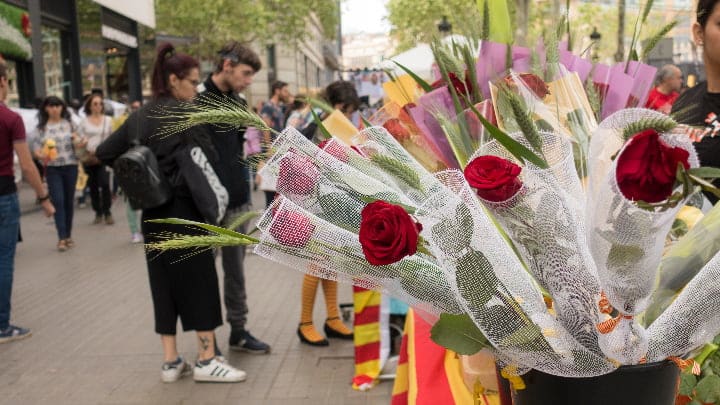
Image of Flower, Flower Arrangement, Flower Bouquet, Rose, Adult, Female, Person, Woman, Male, Man,

While there may not be a specific time in the year that makes for the ideal couple’s retreat across the board, there are a couple of notable events that cater largely or even explicitly to couples. If you’re looking for a specific date to work into your trip, these events could be just the ticket.

The first of these is, of course, Valentine’s Day. Like many places outside of America, the celebration isn’t typically embraced by locals, but that doesn’t stop Barcelona being a fantastic destination for a Valentine’s getaway. The city’s many stylish bars and charming restaurants make an ideal backdrop for a romantic day together, and a number of local businesses also embrace the influx of loved-up tourists by offering limited-time gifts and bookings.

Catalonia’s real answer to Valentine’s Day is Día de Sant Jordi on April 23. This day serves as an opportunity for locals and visitors alike to express their love for one another, often with the exchange of gifts. The most commonly exchanged gifts are roses or other such flowers and books, often bought from the many stalls set up throughout the city’s streets for the day.

Although not explicitly reserved for couples, the European Balloon Festival held each July offers a truly hallmark experience for you and your partner. Hosted across four days in nearby Igualada, the festival brings together around 25,000 participants from around the world as they take to the skies. Rides can be booked in advance if you want your own piece of this magical celebration.

Wining & Dining

Image of Urban, City, Indoors, Restaurant, Cafeteria, Cafe, Road, Street, Person, Adult, Female, Woman,

As a destination known in particular for its stunning seaside location, it will come as little surprise that the beachfront is replete with trendy bars and restaurants overlooking the Mediterranean. While you can expect prices to be higher here than businesses based further inland, there are few views in Barcelona more splendid than the Catalan coastline.

You’ll find more of an authentic dining experience throughout the many historical squares and plazas dotted throughout the city, the most popular of which being Plaça Reial. These social hubs are home to a number of independent restaurants, bars and cafés where you can enjoy some of Catalonia’s most celebrated dishes.

If hip and chic are what you’re looking for, then Barcelona has you covered there, too. Many hotels and restaurants throughout the city have rooftop terraces and cocktail bars where you can enjoy panoramic views over the skyline with your favorite beverage in hand. Throughout summer, these venues often expand to include iconic locations such as Casa Batlló and La Pedrera, as they begin to host a number of rooftop concerts and events.

For something just a little more special, many vineyards around Barcelona offer tasting tours and workshops, such as Oller del Mas at the foot of beautiful Montserrat. With over 70,000 hectares of land throughout the region dedicated to wineries and vineyards, Catalonia has truly carved a name for itself among the world of specialty wines, which serve as the perfect accompaniment to a romantic Catalan getaway.

Culture, History & Special Interests

Image of Alley, City, Road, Street, Urban, Arch, Gothic Arch,

Couples looking for a more in-depth experience of Barcelona may enjoy a tour of the Gothic Quarter, complete with insights into its turbulent past dating back over 2,000 years to the original Roman settlement. Once finished, you’ll already be close to all of the Gothic Quarter’s charming squares, where you can sit for a romantic meal and a glass of famous Catalan Cava.

For those with an eye for the arts, some of the best things to do in Barcelona for couples include exploring its generous selection of celebrated art galleries. The Museu Nacional d'Art de Catalunya (MNAC), the Museu Picasso, the Fundació Joan Miró and the Museu d'Art Contemporani (MACBA) are considered to be the city’s best artistic offerings, with a heavy emphasis on contemporary art and Catalan artists.

In the same branch are Barcelona’s many famous museums covering all manner of interests. History buffs should turn their attention toward the Museu d'Història de Catalunya, the Museo de Historia de Barcelona (MUHBA) and the Museu Marítim. Sports fans, on the other hand, may prefer the likes of the FC Barcelona Museum and the Olympic and Sports Museum.

for something just a little different, the Museu de la Xocolata (Chocolate Museum) and Museo Erótico de Barcelona (Erotic Museum) could be the perfect combination for those of a more hedonistic preference.

Robert Heaney
Go City Travel Expert

Continue reading

quirky barcelona
Blog

Quirky Things to do in Barcelona

Are you a bit different from others? Do you lean on the eccentric side? You're welcome here, friend. Gather round, and we'll tell you exactly you can unleash the quirky beast inside you. Barcelona, of course! If you're looking for fun things to do in the Catalan capital that err on the strange side, then you've come to the right place. Here, we'll let you know which are our favorite quirky things to do in Barcelona! Including: Moco Museum Barcelona Segway tour Gaudí Experiència 4D Museum of Illusions and Big Fun Museum Escape Hunt Barcelona and more!   Moco Mayhem Let's kick off our quirky escapades with some leftfield artworks! At the Moco Museum Barcelona, you can find weird and wonderful works from artists past and present. You'll find this modern art marvel at a rather historic place, as it's located in Palacio Cervelló - the former residence of the noble Cervelló family. But step inside its history-soaked walls, and you'll be transported to a world of experimental art, mind-boggling displays, and works that challenge your beliefs and ideology. Soak up pieces from the likes of Banksy, Dali, Warhol, and LaChapelle, which take center stage beside other brilliant works from lesser-known artists.   Segway Sliding Say what you want about Segways, but they're nothing if not quirky. So, why not take one for a spin and let your quirky side shine at Parc de la Ciutadella with a guided tour on two wheels? And don't worry if you're not a Segway pro; every attendee gets a brief introduction to the art of zooming before you set off around the park, soaking up the beautiful green space and seeing the sights. Highlights of the tour include Barcelona zoo, the park's Cascada fountain, and the city's own Arc de Triomf. But really, the star of the show is you, aboard your own personal electronic chariot, embracing your quirky ancestors in all your glory. Easily one of the most quirky things to do in Barcelona, so put your silliest sunglasses on and get to it!   4D Fun If you're visiting Barcelona, you probably have some idea who Gaudí is. For those who don't, let's do a quick recap: one of the world's most famous architects, worked almost exclusively in Barcelona (his hometown), and you'll see his weird and wonderful creations everywhere. There, lesson over. Gaudí's been gone for nearly 100 years at this point, so for the past century, all you could really do was visit his exquisite buildings to get a better idea of the man himself. But not anymore, because now, you can revisit the man, the legend, and his many works in four dimensions! At the Gaudí Experience 4D, you'll get hands-on with digital interpretations of his work, and then plant your bum in a cinema seat as you're transported into his mind. Learn how the world shaped his creations as your seat moves and you feel the wind in your face. It's a truly breathtaking experience, and one we'd highly recommend even if you know nothing about him.   Illusions and confusion What's better than entering one weird and wonderful museum? Well, that would be entering two for the same price! And that deal can be yours if you head to the Museum of Illusions and the adjoining Big Fun Museum! These perspective-defying museums are easily one of the most quirky things to do in Barcelona. At the Big Fun Museum, you'll be shrunk to the size of an ant as you explore the Giant's House. As the name would suggest, everything is comically large, including a shoe, and giant-sized donuts. Very cool. At the Museum of Illusions, you'll walk through 3D paintings by some of Barcelona's most prominent painters. You may feel you can reach out and touch elements of the display, but it's an illusion. You can touch nothing. Look out for dinosaurs, spaceships, and other weird and wonderful things as you fumble your way through this fantastic museum. Great for kids (and bigger kids).   Escape for your life What could be quirkier than being stuck in a room, time ticking away, as you attempt to solve riddles, find clues, and escape? Nothing, really, which is why we owe it to ourselves to include Escape Hunt Barcelona on our list of quirky things to do in Barcelona! This massive escape complex can fit up to 34 people inside (across the facility's 6 rooms), so if you're somehow traveling with nearly three-dozen people, it's the perfect place to get quirky. If you're feeling daring, you can even challenge another team in another room to see who will escape first. And, with stories including Gaudi, Vampiresses, and thieves schools, you're more than likely to have a wail of a time.   Crypt compadres And finally, let's end this list on something a little different. This one's on the macabre side, but we'd still color it quirky. Venture just outside of the city to Colonia Güell, and you'll find a strange village with a secret. Not only is this weird and wonderful throwback founded by the very same Eusebio Güell, responsible for the eponymous Park Güell, but it's also the final resting place of the late, great Gaudi himself, whose works are all over the park! Created back in the late 1800s, Colonia Güell is something of an oddity itself. It's an entirely manufactured town, built by Güell and a hoard of architects with modernism in mind. Then, once you've explored this megalithic art piece slash town, head down to Gaudi's tomb, which is a work of art in itself. Made up of anti-geometric shapes and vibrant colors, Gaudi professed it would have been a monument dedicated to Sagrada Familia, if he'd lived long enough to see it complete. And that's our list of the most quirky things to do in Barcelona! Looking for more fun things to fill your vacation days in the city? Stretch your legs and your mind with Barcelona's best walking tours. Want to soak up some sun, lounge in some sand by the sea, and take a load off? Browse the city's best beaches. Need a bite to eat, or some fresh food in a pinch? Head to one of Barcelona's excellent markets.
Dom Bewley
Wide view of La Rambla Barcelona - tree lined street, shoppers and stalls
Blog

Things to do on La Rambla Barcelona

Legend has it when you take a sip from the Font de Canaletes fountain at the top of La Rambla, you’ll fall in love with Barcelona and be bound to return! We’re not sure if it really is something in the water or the sensational shopping, delicious tapas treats and awe-inspiring Gaudi buildings that make us want to come back again and again. But there’s no doubt that the heart of the city is La Rambla, the busy, buzzy, tree-lined street which connects Barcelona’s main square to its vibrant waterfront. Looking for the best things to do on La Rambla? Let us take you for a roam - or ramble - around its highlights.   What is La Rambla? One of the main routes through the city for both locals and visitors, its name comes from the Arabic word ramla – for sand – referring to the sandy river bed of the stream that, until the 15th century, ran from the mountains to the sea on the site of this now throbbing thoroughfare. You’ll notice that the paving underfoot is patterned like waves to reflect these watery origins. Now it flows with people day and night - both locals and tourists strolling past souvenir stalls, street traders, human statues, performers, pavement cafes and bustling bars. Is it La Rambla or Las Ramblas? Not everyone realises this most famous of boulevards is one of several ‘Ramblas’ in the city. It is often also known in the plural, as Las Ramblas, because it’s made up of a series of shorter streets. At its top end you’ll find Placa de Catalunya, Barcelona’s main square, where the old city and the 19th century Eixample district meet. To the west is the bohemian El Raval quarter and to the east the Gothic Quarter, with its tempting labyrinth of small squares and streets. La Rambla meanders down to Port Vell where a wooden boardwalk leads to more shops, eating places and the Barcelona Aquarium   Barcelona Flower Market Back in the 19th century the part of La Rambla known as La Rambla de las Flores was the only place in the city where flowers were sold. Today it’s still a riot of colourful blooms, with some of the stalls over one hundred years old. In April the flower stands are painted red to celebrate the tradition of buying roses on La Rambla for the festival of Sant Jordi.   Mercat Boqueria Through the wrought-iron gates on La Rambla, don’t miss La Boqueria one of Europe’s most famous food markets. It’s popular with tourists but it’s also where shoppers and chefs alike buy their produce, from specialist stalls with amazing displays of fruit and vegetables, cured meats, fish, cheese, olives, spices and more. Pick up some picnic ingredients, choose a brightly coloured fruit smoothie, or snack on a ‘cone de jamon’. Or make like the locals who chow down on churros dipped in thick hot chocolate or linger with a glass of cava at one of the tapas bars whilst watching the world go by.   Liceu Opera House Get your culture fix at this majestic 19th century building where you can take in everything from opera to ballet to pop gigs. Despite being gutted by fire not once but twice, in 1861 and again in 1994, the Gran Teatre del Liceu reopened in 1999 and since then has welcomed some of the most famous classical singers of recent years. Marvel at the magnificent foyer, the dazzling hall of mirrors, not to mention the state-of-the-art auditorium, on one of the daily guided tours.   La Rambla street performers Is that statue looking at you? It probably is. La Rambla is famous for its street performers, in particular living statues who, with the help of elaborate makeup, spend hours frozen in place then occasionally surprise an unsuspecting passer-by. Outside the Teatre Principal you’ll also find portrait artists penning caricatures of famous characters – yourself included!   Where to eat on La Rambla? When it’s time to taste some tapas there’s no shortage of places to eat on La Rambla. Plump for patatas bravas, salty Padron peppers, traditional Catalan croquettes or get adventurous with typical Barcelona dishes like char-grilled octopus, and bunuelos de bacalao (salt cod). Take time to people watch from the pretty terraces with a cafe con leche (milky coffee). Coffee has clearly stood the test of time since the popular coffee house and chocolateria Cafe de l’Opera first opened its doors (and pretty stained glass windows) on La Rambla in 1929. Perhaps you’ll duck into Pasteleria Escriba - the most famous patisserie in town - for a sweet treat, or kick back with a cocktail at one of the many bars frequented by tourists and locals alike.   Miró mosaic Don’t miss the Miró! Not everyone realises there’s an enormous mosaic by one of Barcelona’s most famous artists, Joan Miró, right under their feet, just outside La Boquería. Constructed in 1976, the circular creation, around 8m in diameter, uses the bright primary colours and thick black lines for which Miro is best known. Look carefully for the single tile that carries his signature. 2017 Memorial Tragedy struck the city in 2017 when 15 people lost their lives and dozens more were injured in a terrorist attack right in the heart of La Rambla. To honour them the City of Barcelona placed a 12 metre long memorial next to the Miro mosaic. Pay your respects as you read the message denouncing violence, in Arabic, English, Spanish and Catalan – ‘Peace come upon you, oh city of peace’. Musee de l’Erotica Cool or controversial? You decide. This quirky museum based on the theme of eroticism throughout history claims to have been set up for educational purposes. Home to more than 800 pieces, it’s your chance to explore how different cultures have been titillated by raunchy and even religious objects dating back to Roman times. If you’re still not sure, it’s worth remembering that the museum also serves Cava to its visitors!   Christopher Columbus Monument At the bottom of La Rambla, this 197ft tall Corinthian column, topped by a bronze statue, marks the spot where the famous explorer first set foot back into Catalonia after his trip to the New World. Why not take the lift up to his lofty pedestal for a breathtaking view of the city and the sparkling Mediterranean - and decide where you’re going to explore next? An Explorer or All-Inclusive pass means you can mix your pre-booked activities with flexible drop-ins. Choose Go City® and enjoy your adventures!
Jo Cooke
Interior of Casa Batlló
Blog

Casa Batlló Vs Casa Milà Comparison - Gaudí Houses Compared

Gaudí masterpieces don’t come much more spectacular than Casa Batlló and Casa Milá, eye-popping architectural stars of Barcelona’s fashionable Eixample district. Designed and completed by Gaudí in the early 20th Century, these near-neighbors should be considered bucket listers for aficionados of the maestro’s work. Though, frankly, they’re pretty much essential viewing for anyone who possesses a) even a passing interest in unusual architectural design and/or b) an Instagram account. We took a closer look at these iconic Gaudí houses in our Casa Batlló Vs Casa Milà comparison. Scroll for the lowdown… Antoni Gaudí: a (Very) Short History Born in rural Catalonia in 1852, Antoni Gaudí i Cornet rose from humble beginnings to become the chief exponent of Catalan Modernisme, popularizing an architectural style that’s near-impossible to categorize but is always distinctly, inimitably Gaudí. His calling cards included geometrical forms, neo-Gothic flair, colorful mosaic tiling and structures influenced by his deep love of nature – think bones, tree trunks, butterfly wings, and so on. The majority of Gaudí’s buildings – 12 in all – can be found in Barcelona, and are among the most-visited attractions in town. We’re talking the Sagrada Família, Park Güell, Casa Vicens and two of his most flamboyant confections: the UNESCO-listed Casa Batlló and Casa Milà, all of which are included with a Barcelona pass from Go City. Find out more about the pass and how to get yours here. Casa Batlló: The Lowdown Name: Casa Batlló is named for textile magnate Josep Batlló, who commissioned Gaudí’s building redesign in 1904. It’s known locally as the casa dels ossos (house of bones), for reasons which will become apparent… Vital Statistics: Completed in 1906, it took 99 years before Casa Batlló was designated a UNESCO World Heritage Site in 2005. It’s located on the stylish Passeig de Gràcia in Barcelona’s Eixample district, and is one of the city’s most popular attractions, welcoming around a million visitors every year.  Casa Batlló in Brief: Casa Batlló is a pure flight of fantasy, with a hallucinatory exterior that will appeal to everybody from high-art aficionados to fans of Game of Thrones. Considered one of Gaudí’s crowning glories, it’s truly a sight to behold. The striking dragon-crest roof fairly shimmers with blue-and-green ‘dragon scale’ tiles. Glass, stone and ceramic mosaic gives the facade a textured, rough-hewn look, while the skeletal carapace and creepy skull-mask balconies on the lower levels are what earned Casa Batlló its ‘house of bones’ nickname. Things are no less bonkers inside, where the staircase is designed to resemble a spine and the entrance hall feels  a bit like being in an underwater cave, complete with tortoise-shell skylights. Three Highlights of Casa Batlló: The Noble Floor. The former residence of the Batlló family features a gently undulating ceiling, mushroom-shaped fireplace and huge gallery which protrudes far over the Passeig de Gràcia. Roof Terrace. Ogle fairytale mosaiced chimneys and get close-up views of the dragon’s scaly back. Indoor Garden. This highly decorative terrace, with colorfully tiled floor and flowerpots is a tiny oasis in the heart of Barcelona. Casa Milà: The Lowdown Name: Casa Milà is more commonly known locally as La Pedrera, aka ‘the quarry’, thanks to its unusual rough-hewn facade. Vital Statistics: The last house Gaudí worked on before applying himself full-time to the Sagrada Família, Casa Milá was built between 1906 and 1912, and designated a World Heritage Site by UNESCO in 1984. No more or less popular than its near-neighbor Casa Batlló, La Pedrera also attracts around a million annual visitors. Casa Milá in Brief: La Pedrera was pretty controversial when it was first built. And by controversial we mean the locals hated it. Hence the somewhat unfair nickname. History has of course been much kinder to Gaudí’s legacy and this Barcelona icon is now widely accepted to be one of the finest examples of Catalan Modernisme, all sinuous limestone curves, intricate wrought-iron balconies, and soaring mosaic-clad chimneys. Great paintings, tapestries and frescoes adorn the eye-popping interiors; rooms are also kitted out with curvaceous furnishings by Gaudí himself, each designed to slot seamlessly into the building’s flowing waves and curves. Three Highlights of Casa Milá: Roof Terrace: a total of 28 extraordinary warrior-like stone chimneys stand sentinel on the Casa Milá rooftop, vying for attention against some fairly spectacular 360-degree views of the city skyline. The Whale Attic. Come over all Jonah as you enter what appears to be the belly of a leviathan, thanks to 270 arches representing a whale’s ribcage. If that’s not enough, there’s also a quite excellent Gaudí exhibition to explore up here. Courtyards don’t come much trippier than La Pedrera’s Flower Courtyard and Butterfly Courtyard, in which you can expect fantastical shapes and colors, complemented by beautiful blooms and great Ballard-esque insects that are quite at odds with the far more sober exterior. Casa Batlló Vs Casa Milà Comparison: Which is Best? Who could possibly pick a favorite from these two extraordinary Gaudí Houses? Both Casa Batlló and Casa Milà are like nothing you’ve seen before, each with its own set of architectural quirks and fantastic visual spectacles. Here’s the good news: you don’t have to visit just one or the other. Not only are these dreamlike townhouses just a few minutes’ walk from each other; both are included with a Barcelona pass from Go City. The pass is ideal if you’re planning to see a number of top attractions on your vacation, and includes entry to Casa Batlló and Casa Milà, plus other Gaudí masterpieces including Casa Vicens and tours of the Sagrada Família and Park Güell. It also gives you access to many more Barcelona tours, activities and attractions, like the Picasso Museum and Barcelona Zoo, and could save you up to 50% on regular prices. Find out more about the pass and get yours here. Save on Attractions, Tours and Activities in Barcelona Save money on Barcelona attractions, tours and activities with a pass from Go City. Check out @GoCity on Instagram for the latest top tips and attraction info.
Stuart Bak
Stuart Bak

Have a 5% discount, on us!

Sign up to our newsletter and receive exclusive discounts, trip inspiration and attraction updates straight to your inbox.