
Guide to the Louvre Museum - Tips for Visiting

Published: July 18, 2024
Louvre Museum

If you do one thing in Paris, it should be the Louvre. Pay a visit to the world’s largest art museum and spend an entire day marveling at their exhaustive collections of art and artifacts. It's consistently among the most-visited art museums and one of Paris’ most popular attractions.

While their collections encompass some 380,000 objects, only a portion of these are on display at any given time. Items hail from all around the globe and throughout human history, including objects from prehistory all the way up to twenty-first-century works of art. The Louvre has particularly notable strengths in Egyptian Antiquities, Greek, Etruscan, and Roman Antiquities, Sculpture, and Painting, among others.

The museum itself is a work of art—housed in the Louvre Palace (originally built in the late twelfth century as the Louvre Castle), it’s a veritable maze of art and artworks. Creative types will find a haven here, with something from just about every period and field to marvel at.

Don’t forget about the signature I. M. Pei pyramid out the front which acts not only as a piece of art but a stunning entranceway to the museum!

default alt tag

The Louvre Tickets

Looking for discount tickets to the Louvre? Grab a pass from Go City. Spend less on admission to the Louvre and dozens of other museums, tours, cruises, and other great Paris attractions. Enjoy 2, 3, 4 or 6 days of unlimited sightseeing and save big on combined admission versus paying at the gate. See more on pricing for our passes.

Louvre Tips for Visiting

  • Be sure to download an interactive floor plan prior to your visit — it’s available in seven languages and will be invaluable in helping you plot out your course through the museum.
  • Consult the museum calendar to see what special events, gallery talks, or tours are going on during the day of your visit.
  • You may also wish to grab an audio guide for the Louvre. Available in seven languages, this is one of the coolest and more comprehensive audio guides around.
  • The Louvre is big—like, really big. Wear comfortable shoes and plan to rest periodically.
  • The Louvre is also difficult to navigate, but they’ve really simplified things by making their collections color-coded. Each of the eight curatorial departments is assigned a color, and then each room within the department is given a number. Follow your map and the signs on the wall and you’ll be good to go.
  • Take your kids to the Touch Gallery. It’s the only place in the entire museum where visitors are encouraged to touch the sculptures (which are replicas of those found in the museum’s collections).
  • Other important places like elevators, restrooms, and restaurants are identified via pictograms—so no worries if you don’t read French.
  • For those visitors traveling with little ones, check out the Tuileries Gardens, which are filled with kid-friendly activities like a carousel, trampolines, and little boats.
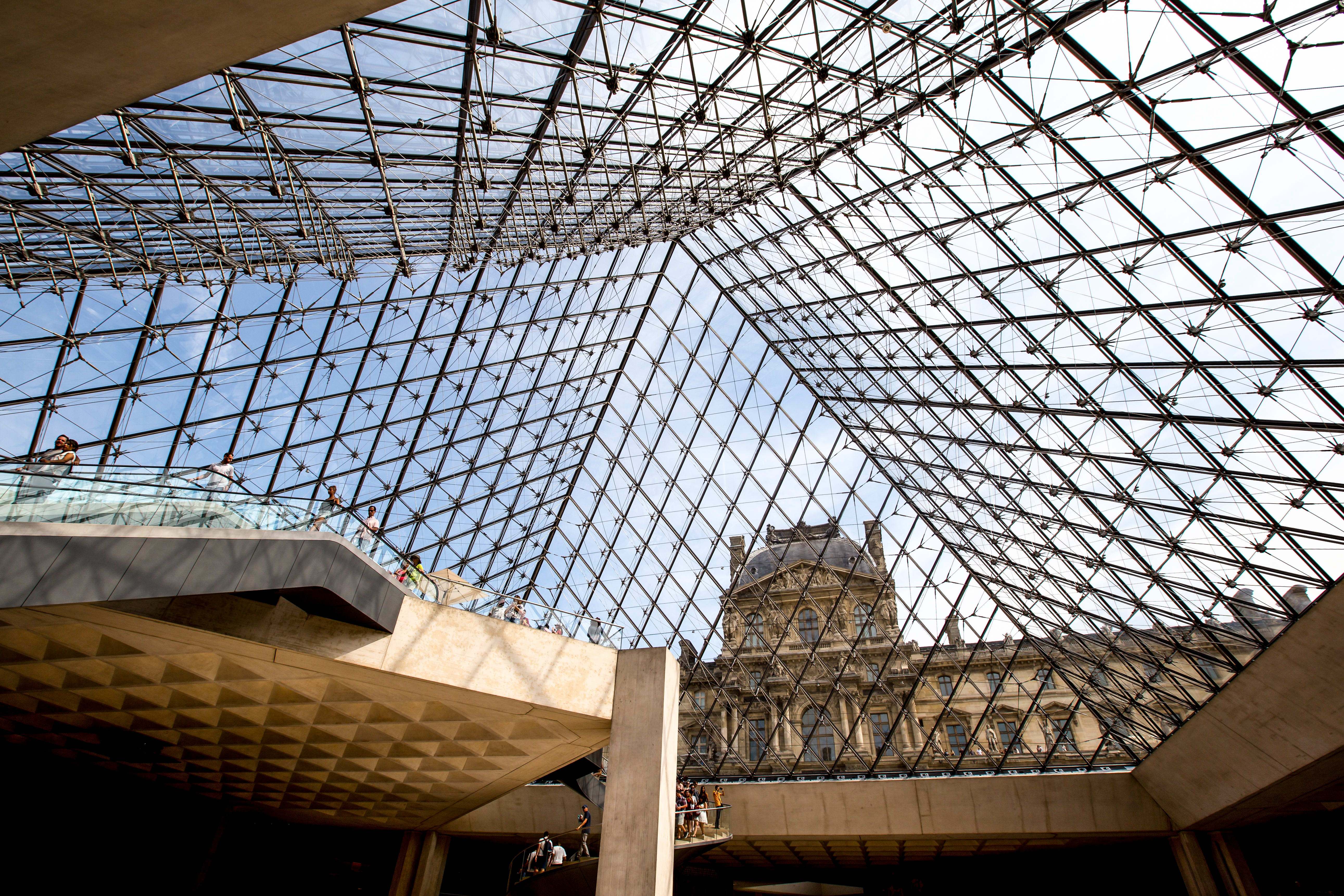
Image of Skylight, Window, Person,

What is the Best Time to Go to the Louvre?

You should plan to spend most of the day at the Louvre if you want to see a representative sample of the exhibits; it is also possible, however, to organize a “highlights” tour and accomplish it all in a few hours. We recommend visiting the museum first thing in the morning as soon as they open to maximize your time spent inside the institution. Crowds will be heavier mid-morning and late afternoon. If you're trying to attend a special docent tour, it’s wise to consult the museum’s schedule of events to see what’s available during the day of your visit.

What to Bring to the Louvre

  • Comfy walking shoes – the floors are hard and you’ll be traipsing around quite a bit.
  • Money for souvenirs – their bookstore is one of the best places to shop for tourists in the entire city and it’s worth spending some time there.
  • Layers – the museum is climate controlled, but this can differ depending upon the type of art. As a result, you may feel cool in some rooms but warmer in others.
  • A camera—there are places in the Louvre where photography is limited or prohibited, but you’ll want it on hand for the opportunities that do arise.

What to Do at the Louvre

The museum collections are all sorted into one of eight curatorial departments: Egyptian Antiquities; Greek, Etruscan, and Roman Antiquities; Near Eastern Antiquities; Islamic Art; Paintings; Sculptures; Decorative Arts; and Prints and Drawings. We’ve listed a few of the highlights of each department below.

Egyptian Antiquities

One of the most famous collections within the Louvre’s vast holdings, the department of Egyptian Antiquities is filled with hundreds of items from Nile Valley civilizations. Items date as far back as the prehistoric period (about 4000 BCE) all the way to the early Christian period (around the fourth century CE).

The objects in this department include everything from small pieces of jewelry, games, funeral urns, and amulets to large sarcophagi, engraved portions of tomb walls, and statuary.

Greek, Etruscan, and Roman Antiquities

Spanning the rich, diverse cultures of Greece, Italy, and the broader Mediterranean area, the objects and artifacts in this department range from the Neolithic era to the sixth century CE. Here is where fans of classical archaeology and mythology will find their inspiration.

With art objects that cover everything from the iconic amphoras to intricate statues of the gods to the signature black and red Greek pottery, you’ll be amazed at the breadth and depth of these collections.

Near East Antiquities

One of the broadest categories of art and objects at the Louvre, the Near East Antiquities department spans an astonishing nine thousand-year period—from prehistory to the early Islamic period. Artifacts were discovered in a wide range of territory, from North Africa to Central Asia, and from the Black Sea to the Arabian Peninsula.

Highlights of this department include tablets bearing some of the earliest forms of writing, ancient beaded jewelry, board games, and dozens of religious statues and figures.

Islamic Art

New galleries in this department opened in 2012, allowing for an expanded display of Islamic artwork for Louvre visitors. There are a few thousand objects on display here, ranging geographically from Southeast Asia to Spain, and temporally across nearly 1,300 years of human history. A few of the objects you might see in this department include dishware and pottery, sculptures, textiles and texts, and manuscript pages.

Paintings

With a couple hundred works currently on display, paintings are one of the larger curatorial focus points at the Louvre. This department is among the most famous as well, with particular strengths in Italian Renaissance art and Dutch Old Masters. The collection encompasses every major European school of painting as well, including works from the thirteenth through the nineteenth centuries.

Some of the most famous works in this collection include Leonardi da Vinci’s world-renowned Mona Lisa, Eugène Delacroix’s Liberty Leading the People, and Johannes Vermeer’s The Astronomer.

Sculptures

The Department of Sculptures has had a long and varied history, currently encompassing Medieval, Renaissance, and Modern sculptures. Every work here dates prior to 1850, and only includes those that do not qualify for the Greek, Etruscan, and Roman Department.

Some of the most stunning art objects in the entire Louvre are found here, ranging from statues of gods and goddesses to biblical characters to modern individuals of note.

Image of Apse, Building, Church, Altar, Prayer,

Decorative Arts

One of the best departments for those who appreciate and/or study the history of material culture in a global context, this area of the Louvre boasts a simply stunning collection of objects from around the world. Objects were created between the early Middle Ages and the mid-nineteenth century. You’ll find everything from jewelry and ivory work to stained glass and furniture. Many of these objects inspire us to wonder what will happen to our own precious goods after we’re gone.

Prints and Drawings

This is one for the history of the book people. Here you’ll find a wide selection of printed material, including drawings, pastels, printed books, manuscripts, woodcuts, and lithographic stones.

The unique thing about this department is its approach to displaying the collections—because of their innate fragility, most works are kept in careful storage and are circulated in and out of temporary displays. As a result, all exhibits here are temporary, so what you see during your visit will be totally unique!

Save on Louvre Tickets with a Go Paris pass

A Go City attraction pass for Paris provides admission to the Louvre and dozens of other Paris and area museums for one low price. You’ll also get admission to tours, cruises, and other top Parisian attractions to round out your weekend getaway.

Katie Sagal
Go City Travel Expert

Continue reading

A couple share a kiss beneath the falling leaves of the Jardin de Luxembourg
Blog

Visiting Paris in September

Paris in September is synonymous with la rentrée – the return of Parisians who have spent the summer on the shores of the French Riviera. For visitors, their return brings an added sense of authenticity to streets still warm enough to want to be out in. Also heralding the beginning of fall, the city’s parks and gardens become a blaze of oranges and reds with the turning of the leaves. But if that wasn’t enough, Paris in September hosts a myriad of events casting a new light over the City of Light. Ready to discover Paris as summer turns to fall? Don’t miss your chance to visit in September! September in Paris Daytime temperatures of over 20°C make getting out and about in Paris a joy in September, with light, quickly moving showers the only fly in the ointment. In short, September is perfect weather for being on the water. Few are able to resist the allure of a River Seine cruise at any time of day, although sunset remains a firm favorite with us. Evening temperatures linger around 13°C, meaning you’ll probably want a sweater to keep the chill at bay. You can also take advantage of the great weather to delve into the side streets of the Montparnasse neighborhood on foot. Lying just a short distance from many of Paris’s world-famous landmarks, the area has long been the bastion of the city’s café culture and intellectual conversation. Notable fans of the area have included Hemingway, Dali and Jean-Paul Sartre, who’s buried in the cemetery which dominates as much as the Tour Montparnasse – the only skyscraper in the Paris city limits. Outdoor adventures Equally impressive are the large-scale sculptures that appear in the La Défense district and the gardens of La Seine Musicale performing arts center at this time of year, creating an outdoor exhibition space with few challengers. When it comes to outdoor public spaces, the Bois de Boulogne is rarely absent from the conversation for long. It’s 2000-plus acres incorporate several individual parks and gardens, as well as September’s Fête à Neuneu. Instigated by no less a figure than Napoleon Bonaparte as Emperor of France in 1815, it’s a funfair filled to bursting with traditional rides and candy floss stalls. The festivals in fact come thick and fast, with the Fête des Jardins (Garden Festival) weekend hot on its heels. Though lasting just two days, it sees parks across the city holding special events. They include live bands, food stalls and guided tours. All are put together to help visitors get the most out of the city’s 150 public green spaces. Indoor marvels With such an array of history on display, you wouldn’t think Paris would be in need of its European Heritage Days. However, this September weekend grants visitors free access to many of Paris’s museums, alongside attractions usually off-limits to the general public. The Élysée Palace, official residence of the French President, behind the scenes areas of the Paris Metro and Hôtel Drouot – an auction house equivalent to Sotheby’s – have all opened their usually closed doors for previous editions. Attractions reopening their doors – this time after the summer hiatus – are the shows that provide entertainment late into the night, including those of the cabaret clubs of Montmartre and Paris’s two main opera houses, the Palais Garnier and Opera Bastille. Get your lips tingling and toes tapping You certainly don’t have to be an opera buff to enjoy a night out in the French capital. To start with, there is no shortage of rooftop bars, still very much usable spaces thanks to the sunny weather of Paris in September. Combine a little panoramic sightseeing with a classic cocktail at the likes of Bar le Perchoir for views of the Sacré-Coeur and Le Georges atop the Pompidou Center for vistas taking in much of the city from seven stories up. Always a focal point for those of a musical bent, with structures including the Paris Philharmonic Hall and the Zenith and Trabendo live music venues, Parc la Villette takes on extra significance in September when it hosts Jazz à la Villette and the Jazz for Kids mini-festival. EDM lovers are also catered for, with the one-day Techno Parade taking over streets in the heart of Paris. Attracting audiences numbering north of a quarter of a million people, the good-time atmosphere sees DJs play a long list of crowd favorites from decks situated on slowly moving floats. Admire the latest trends One of the most stylish cities around, design can be seen everywhere from the Pompidou Center to the fashion shows of the Galeries Lafayette department store. If a single event brings together that je ne sais quoi of apparently-effortless Paris style it’s the city’s Design Week in the first half of September. Schools, workshops and studios all show off their latest collections in an event that could well see you rubbing shoulders with a buyer from any of Europe’s high-end stores. The end of the month also sees the year’s second installment of Fashion Week, with venues across the city turned over to brands big and small. Landmarks are always keen to get involved with the Paris Autumn Festival too. It begins in September and runs through the rest of the year with dance, variety performances and film screenings all part of the program. Save on September Paris attraction admission Is September a good time to visit Paris? We have little difficulty in saying it is. There’s a huge range of events to look forward to and weather conditions which most parts of the world would die for at the beginning of fall. Whether you plan to spend your days scouring the backstreets of Montmartre or delving headlong into the collections of the Paris museums, exploring with Go City will help you keep costs under control. Our pre-paid passes give those visiting Paris in September substantial savings on admission to a long list of major attractions.
Ian Packham
Parisians sitting at exterior cafe tables
Blog

5 reasons to visit Paris in July

The mass exodus of Parisians keen to head south to the shores of the French Riviera begins in July, which seems a little like Monet putting down his paintbrushes in favor of some gardening. Why? Because July is one of the best times of year to visit Paris. Paris in July experiences wonderful summer temperatures of around 23°C, and also hosts some of France’s top annual events. Intrigued? You should be! Here’s 5 very good reasons to visit Paris in July. 1. Bastille Day celebrations Better known in Paris as Le Fête Nationale (National Celebration) and Le Quatorze Juillet (July 14) Bastille Day commemorates the storming of the Bastille prison. Taking place on July 14 1789, it kicked off the French Revolution. Little remains of the prison itself, except for a star-shaped outline on the sidewalks of Place de la Bastille. However, as France’s national day, it’s far from forgotten. The main event is a military parade – the largest in Europe. This makes its way along the Champs-Élysées from the Arc de Triomphe to the Place de la Concorde. Attended by the French President and notable guests – most famously US President Donald Trump – it ends with a magnificent fly past by the Patrouille de France aerobatics team. For more on them, head to the Museum of Air and Space. The attention then turns to the Eiffel Tower. Constructed to mark the 100th anniversary of the French Revolution, the base of the Eiffel Tower is the location of a major concert. As darkness falls, the biggest fireworks display of the Paris year erupts around the tower. Whilst that’s enough for many, the celebrations continue all night long at the central fire stations of each of the 20 arrondissements (districts), which fling open their doors to the public. 2. Museums by night Part of the European Night of Museums extravaganza, Paris’s Nuit des Musées (Museums Night) sees many of the city’s much-loved collections offering free after hours opening. Guests can explore their treasures and take part in special events including workshops. Just some of those which take part are the Picasso Museum and the Museum of Arab History. But if you miss this one-night-only event there are several other options for exploring Paris’s landmark attractions after dark. Nights at Les Invalides combines an immersive sound and light show with the chance to explore Napoleon Bonaparte’s burial place on the banks of the Seine by candlelight. Alternatively, you could turn to the Palace of Versailles gardens on Saturday evenings throughout July. Specially lit for the occasion, music drifts around the groves and fountains before the sky erupts into a sea of fireworks. 3. Make the most of the good weather With glorious July sun and warm evenings pretty much on tap, there’s plenty of reason to linger in Paris’s public outdoor spaces. Take a Bateaux Parisiens Seine river cruise and you might be surprised to see beachgoers lining the river’s banks. Those unable to up sticks to the French Riviera for the summer season are at least able to sink their feet into the imported sand of the Paris Plages beaches. Of the many reasons there are for exploring the parks and gardens of Paris in July, one of the best has to be the Fête de Tuileries. Located just behind the Louvre, it takes the form of a traditional funfair, complete with wooden carousels, a ghost train and hall of mirrors. Meanwhile, Parc de la Villette hosts an open-air cinema for much of the summer. One best suited for night owls, screenings can only take place once it’s got dark enough, meaning the mix of classic and modern movies don’t get their curtain call until 10:00 – 10:30PM. 4. Join the festival crowds On the eastern side of the city, the Parc Floral within the Bois de Vincennes becomes the site of the two month long Paris Jazz Festival. The eclectic line-up includes many of the greatest names in jazz, which in the past has seen both Gregory Porter and Sandra Nkaké take to the stage. Crossing musical genres, Festival Fnac Live has a commanding position in the courtyard of the Hôtel de Ville (City Hall) building. The free event lasts three nights and welcomes somewhere in the region of 100,000 revelers keen to see acts that have included Sting, Shaggy and Ed Sheeran. The lesser-known Canal de l’Ourcq around the Bassin de la Villette also comes into its own in July. As well as being a lovely place to soak up the sun with a canal-side stroll, it hosts a number of July events ranging from concerts to urban art trails suitable for all the family. 5. Bikes and shopping bags If one major July spectacle on the Champs-Élysées in July wasn’t enough in the form of the Bastille Day celebrations, then there’s the grand finale of the Tour de France to look forward to. The bike pack arrives in the capital after a route covering approximately 2200 miles. Ending with several laps of the Arc de Triomphe – and the impressive feat of cycling over cobbles whilst sipping from a Champagne flute – it’s a great way to get close to any cycling heroes. If it’s shopping bags rather than bikes that interest you, Paris in July is still the place to be. The time of the traditional summer sales, stores throughout the capital can offer significant discounts on ordinary retail prices, with the best deals generally appearing towards the end of the sales period. Should luggage space prevent you from making too many purchases, the stores of streets like Boulevard Haussmann are still well worth visiting. They include department stores Au Printemps and Galeries Lafayette, whose impressive art nouveau interiors have been drawing crowds for over 100 years. Saving on attraction admission in Paris in July With so much going on, you might think you’re going to need a significant win on the loto (the French lottery) to pay for it all. But even if lady luck isn’t standing by your side, it’s still possible to do all you want without worrying about the cost. Although Paris is considered an expensive city to both visit and live in, there are ways visitors to the French capital can ensure their money lasts. Explore Paris with Go City and you’ll get the benefit of reduced admission on many of the city’s top tourist attractions. What’s more, you can do this without needing to make any firm decisions about what you’d like to visit or when until you’re all set to immerse yourself in Paris in July.
Ian Packham

Have a 5% discount, on us!

Sign up to our newsletter and receive exclusive discounts, trip inspiration and attraction updates straight to your inbox.